
If you live in a cold and snowy region, then you’re probably well acquainted with the importance of attic insulation. A well-insulated attic can conserve heat, prevent damage due to dampness, and reduce the numbers on your energy bills.
But even though the radiator works perfectly, your home keeps getting cold somehow? If that’s the case, then your attic access needs insulation as well. Or precisely, you need attic door insulation.
 Why is it important? Because the attic access is less concealed compared to the other parts. Due to this lack of concealment, the heat circulating inside the house keeps radiating outside.
As a result, the interior temperature keeps dropping and your heater runs overtime. And your energy bills tell the rest of the story.
So in this article, we’re bringing you some of the best attic door insulations that may provide the warmth you’ve been missing.
Top pick #1 Attic stairs insulation cover

Whistler Attic stairs insulation cover fireproof & extra thick
This product has been chosen as our #1 pick. It’s an excellent attic cover, resistant to fire and water alike. It has a relatively high insulation R-value. The R-value reflects the heat transfer rate per unit is also known as heat flux.
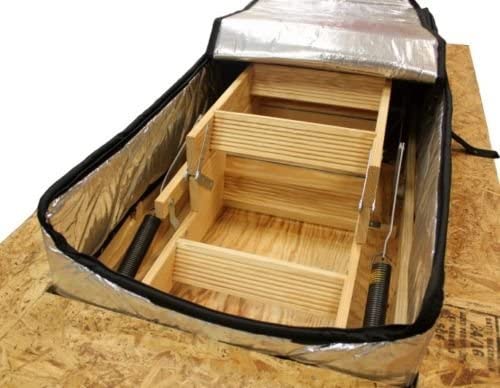
The product is easy to install and use. It can cover an opening of 25” x 54” and erects about 11” above the attic floor. The front is lower for easier access. The insulator can be accessed via a zipper.
Whistler staircase insulation works incredibly all year, cold winters, and blistering summers. On the off chance that you had issues with heat during summer and cold air getting into the corridor under the upper room entryway, at that point this loft steps protection spread will take care of your concern.
Air seals the attic and reflects up to 95% of heat. Insulates your home from the harshest of winters. Saves energy and greatly reduces the pressure on your wallet.
Judging from the user reviews, this product provides the best attic stair insulation at the moment. It’s user friendly and can be installed very quickly. And at the listed price, it’s a great deal without a doubt.
However, the product has been criticized for questionable quality control. The zipper isn’t sturdy enough and may come off after a few uses. Also, the stitching quality may not be up to the mark.
Technical Specifications:
- Brand: Whistler
- Product: Attic stair insulation
- Weight: 1.23 pounds
- R-Value: 14.5
- Dimensions: 25” x 54” x 11”
- Opening: Zipper
Pros:
- Install within 10 minutes
- Reflects and retains heat
- User-friendly design
- Great protection throughout the year.
- Cost-effective
Cons:
- Zipper breaks easily
- Poor build
- Stitching comes apart
The Best Attic Pull Down Stair Insulation Covers
| Product Name | Material | R-Value |
| Whistler Attic stairs insulation | Reflective Composite | 14.5 |
| EnergyWise Attic Stair Insulation | Aluminum | 15.5 |
| Attic Tent – 4 Insulator | Nylon | 6.6 |
| Panady attic stair insulation | Aluminum | 15.3 |
| Attic Tent AT-5 – Nylon cover | Nylon | 3.3 |
| Owens Corning Attic Insulator | Fiberglass | 10 |
| US Energy Product Attic Ladder Insulation | Reflective Composite | 15.67 |
| AES – Pull Down Attic Ladder Cover | Aluminum | 10 |
The top best product [hide]
Best Budget Buy: EnergyWise Attic Stair Insulation Cover With Easy Zipper Access

We’ve chosen this product as our best budget buy. It’s the attic stair insulation blanket we have gotten from the Energy-wise brand and it is extraordinary compared to other stair covers in our top rundown.
The spread is included with double layer aluminum material of premium quality alongside 97 percent reflection capability. Has an R-value rating of 15.5, which is slightly higher than our top choice. The initial access measure is 25″ x 54″ x 11″ inches and fits almost any attic stair opening.
Additionally, high heat reflection makes it a convenient choice for saving energy bills. Also, its presentation isn’t influenced by dampness. You can consolidate it with other protective measures.
Notwithstanding, this most recent developed quality forestalls undesirable heat channeling, in both blistering summer and cold winter. Also retrains the air spill, pollutant particles, residue, and bugs from entering into your home.
For additional comfort, this attic door cover has zipper access for simple opening and shutting and easy introducing measures. Thanks to the simple design, you should be able to install it within minutes. Simply staple the cover to the framing and you’re all set.
Technical Specifications:
- Brand: Energy Wise
- Weight: 1.5 pounds
- Dimensions: 25″ x 54″ x 11″ inches
- R-Value: 15.5
- Opening: Zipper
- Material: Two-layer Aluminum material
Pros:
- Best budget buy
- Excellent insulation properties
- Reflects and retains heat
- Keeps out dust and bugs
- Install within 15 minutes
- Aluminum body for convenient protection
- No effect of moisture and humidity
Cons:
- Questionable durability
- The thin material body may rip easily
- The zipper may come off
Best Attic Door Insulation: Attic Tent – 4 Insulator With Rough Opening

The Attic Tent cover provides the best attic stair insulation. It covers a 25″ x 54″ x 13″ area. All Attic Tents are uniquely built, licensed protectors intended to make an airflow obstruction between your attic and living territories.
Primary Materials incorporate Polyurethane Form + Flame Retardancy along with Nylon Fabric. The Attic Tent is a definitive upper room access protection spread at any point imagined. Its essential plan is to stop air penetration between the home and loft, which causes energy wastage and inflated bills during both hot and cold seasons.
The HVAC framework is a critical system that balances airflow. Each time these frameworks are working they make a positive or negative weight, in this way an air circulation system slowly develops.
Additionally, this insulator keeps out undesirable dust, dirt, and bugs. The Attic Tent has been given an R-estimation of 6.6 by the Oak Ridge National Laboratory. At the point when the Insulator is reinforced with R-30 cases, the R-estimation of the joined Attic Tent bounces to 36.6.
Also, when amplified with R-38 cases, the R-estimation bounces to 44.6. This is why the Attic Tent Insulator provides the best attic stair insulation and is featured as our #3 top pick.
Technical Specifications:
- Brand: Attic
- Weight: 3.79 pounds
- Dimensions: W–25”, L-54”, H-13”
- R-Value: 6.6, Boosted with cases.
- Material: Nylon
- Color: Silver
Pros:
- Provides the best possible insulation
- Restricts airflow through the attic opening
- Saves energy and bill
- Fits well
- Durable Nylon Body
- Quick installation
Cons:
- Not very protective without the case
- Poor durability
- Relatively expensive
Up until now, we’ve featured information on different aspects regarding attic insulation. If you followed the guide, no doubt you’re close to becoming an expert. However, we understand you don’t have much time to go through all the geek stuff.
So here are 5 best attic door insulations other than the previously stated ones. Check em out, compare, and make the purchase.
Panady attic stair insulation – Fireproof attic access cover
 Panady brings this unique cover that’s more tent-like, rather than a cover. It fits standard attic openings and sizes 25" x 54" x 11" inches.
The product is designed by professional insulation contractors in the USA. It features a double bubble technology made of xpe/epe foam retains heat and repels cold during winter. The zipper quality is also commendable.
Also, the spread reflects 97% of the heat and the bubble layer assists with hindering the warmth obstruction alongside residue or toxins passage into your home.
Besides, it comes with a 15.3 R-Value and high HVAC efficiency that saves energy, reduces wastage, and lowers energy cost.
Panady brings this unique cover that’s more tent-like, rather than a cover. It fits standard attic openings and sizes 25" x 54" x 11" inches.
The product is designed by professional insulation contractors in the USA. It features a double bubble technology made of xpe/epe foam retains heat and repels cold during winter. The zipper quality is also commendable.
Also, the spread reflects 97% of the heat and the bubble layer assists with hindering the warmth obstruction alongside residue or toxins passage into your home.
Besides, it comes with a 15.3 R-Value and high HVAC efficiency that saves energy, reduces wastage, and lowers energy cost.Attic Tent AT-5 – Nylon cover
 This Attic Tent cover provides the best attic stair insulation. It covers a 30" x 50" x 13" area. Slightly larger than AT-4, or best insulation selection. All Attic Tents are uniquely built, licensed protectors intended to control and restrict airflow between your attic and house.
Among the primary materials, you’ll find Polyurethane Form + Flame Retardancy along with Nylon Fabric. The Attic Tent is a definitive upper room access protection spread at any point imagined. Its essential plan is to stop air penetration between the home and loft, which causes energy wastage and inflated bills during both hot and cold seasons.
Additionally, this insulator keeps out undesirable dust, dirt, and bugs. The Attic Tent has been given an R-estimation of 3.2 by the Oak Ridge National Laboratory. At the point when the Insulator is reinforced with R-30+ cases, the total R-value increases.
This Attic Tent cover provides the best attic stair insulation. It covers a 30" x 50" x 13" area. Slightly larger than AT-4, or best insulation selection. All Attic Tents are uniquely built, licensed protectors intended to control and restrict airflow between your attic and house.
Among the primary materials, you’ll find Polyurethane Form + Flame Retardancy along with Nylon Fabric. The Attic Tent is a definitive upper room access protection spread at any point imagined. Its essential plan is to stop air penetration between the home and loft, which causes energy wastage and inflated bills during both hot and cold seasons.
Additionally, this insulator keeps out undesirable dust, dirt, and bugs. The Attic Tent has been given an R-estimation of 3.2 by the Oak Ridge National Laboratory. At the point when the Insulator is reinforced with R-30+ cases, the total R-value increases.Owens Corning Attic Stairway Insulator
 The Owens Corning Attic Stairway Insulator is a powerful item for protecting your attic with the goal that your home remains agreeable throughout the entire year. The protection is appraised at R-10 and is made with Owens Corning pink fiberglass protection and intelligent foil.
The unique prism shape reduces weak points and gives variety. It leaves enough breathing room while providing sufficient protection.
Owens Corning is the universes driving producer of fiberglass protection, an organization that you can trust. This item doesn't need any complicated installation. Just simply put it over your steps.
The Owens Corning Attic Stairway Insulator is a powerful item for protecting your attic with the goal that your home remains agreeable throughout the entire year. The protection is appraised at R-10 and is made with Owens Corning pink fiberglass protection and intelligent foil.
The unique prism shape reduces weak points and gives variety. It leaves enough breathing room while providing sufficient protection.
Owens Corning is the universes driving producer of fiberglass protection, an organization that you can trust. This item doesn't need any complicated installation. Just simply put it over your steps.US Energy Product Attic Ladder Insulation with Reflective Foam Core
 It’s a unique insulator with reflective foam core. R-value rated up to 17. Provides good insulation and thermally isolates the attic from the rest of the house.
Its installation is very easy. Doesn’t require any special operations. And also doesn’t involve any fume and fiber.
The product is made in the USA. Inexpensive compared to other similar products on the market. But provides great protection nonetheless.
Greatly reduces energy waste and lowers cost.
It’s a unique insulator with reflective foam core. R-value rated up to 17. Provides good insulation and thermally isolates the attic from the rest of the house.
Its installation is very easy. Doesn’t require any special operations. And also doesn’t involve any fume and fiber.
The product is made in the USA. Inexpensive compared to other similar products on the market. But provides great protection nonetheless.
Greatly reduces energy waste and lowers cost.AES – Pull Down Attic Ladder Cover
 To show you various classifications spread the following, we have accompanied a drawdown ladder cover taken from AES. Even though it is for a pull-down attic stair, it’s appropriate for the entrance size 25" x 54" x 10" inches.
The spread is developed with aluminum and air pocket protected inside to assist you with sparing all year vitality into your home. In any case, the material reflects 97% of heat and has an R-estimation of 10, so you can anticipate extraordinary usefulness.
Thusly work immediately and forestall the entering of undesirable warmth, cold, dust, poisons, bugs into your home.
Moreover, the aluminum layer constructs a water, dampness opposition, and stickiness obstruction and keeps your home agreeable even in outrageous external climate conditions.
For additional comfort, this attic door cover has zipper access for simple opening and shutting and easy introducing measures. Thanks to the simple design, you should be able to install it within minutes. Simply staple the cover to the framing and you’re all set.
To show you various classifications spread the following, we have accompanied a drawdown ladder cover taken from AES. Even though it is for a pull-down attic stair, it’s appropriate for the entrance size 25" x 54" x 10" inches.
The spread is developed with aluminum and air pocket protected inside to assist you with sparing all year vitality into your home. In any case, the material reflects 97% of heat and has an R-estimation of 10, so you can anticipate extraordinary usefulness.
Thusly work immediately and forestall the entering of undesirable warmth, cold, dust, poisons, bugs into your home.
Moreover, the aluminum layer constructs a water, dampness opposition, and stickiness obstruction and keeps your home agreeable even in outrageous external climate conditions.
For additional comfort, this attic door cover has zipper access for simple opening and shutting and easy introducing measures. Thanks to the simple design, you should be able to install it within minutes. Simply staple the cover to the framing and you’re all set.Attic Door Insulation – Buying Guide
We’ve already talked about the importance of insulating the attic door. But when you’re out shopping for the best buy, a few nudges here and there can set you in the right direction.
So we’ve prepared a detailed buying guide that’ll provide you with the necessary information and help you make a perfect choice.
Insulating The Attic
Why use home attic insulation? And why is it important? Well, simply putting, insulating the attic will keep your house warm and comfy during the harshest of winter. The insulation retains the inner heat and repels cold, saving a healthy amount of energy bills.
Insulation can be done using filler materials during construction time or later. There are various types of insulating materials out there like loose-fill, batts, mineral wool, cotton, etc. Some people also prefer insulation carpets found in the retail market.
The most common parameter that shows what kind of insulation you need is R-value. The R-value shows the amount of heat retained despite the radiation. According to the department of energy, the minimum R-vales in general are,
- Hot climates – R-30
- Temperate climates – R-38
- Cold climates – R- 49
Also, check out this link for detailed insights.
Insulation of the attic door
Attic insulation alone won’t be enough unless you have the attic door or accessway insulated as well. The attic door opening leaks out a considerable amount of heat. And such circumstance causes a lot of energy wastage and reflects on your bills.
To tackle it, you need an attic stair insulation cover. Attic stair insulation is utilized to isolate the attic from the rest of the house. Having an appropriately protected attic can likewise help forestall dampness issues as well.
Around half of a home’s energy is utilized to warmth or cool the indoor air. If your attic steps are missing protection, at that point a huge energy waste can occur through the opening.
You can find out more about attic door insulation from here.
How to Insulate an Attic Door
Before starting the insulation process, you should understand a few things. If you just jump to work, it’ll do you more harm than good. So you need a clear idea of what you’re getting yourself into.
Before insulating the attic door
Follow the steps below and get an understanding. Hopefully, it’ll make installation much easier.
- Insulate the whole attic if you haven’t already. It won’t make any sense if you go through all the trouble to insulate the accessway when your attic is unprotected.
- In case your attic is already insulated, check if it’s still working properly. Search for leaks and damages. Unattended leaks may leak out a significant amount of heat during the winter.
- Patch the leaks and any other unconcealed area that your inspection may have revealed.
- Check weather stripping around the attic hatch. Fix/replace if necessary.
- You could install fiberglass behind the attic hatch door.
Attic door insulation process
As you begin to insulate your attic, there are some consecutive steps to follow. Both for precaution and perfection.
First of all, make sure you have completed the preliminary steps. To work on the door insulation, you need some tools, materials, and safety gear. Check out this link for a complete, step by step guide.
Tools
Some of the frequently used tools are,
- Caulking gun: Squeezes out sealant materials. Used to seal openings, leaks in the frame, or holes.
- Staple gun: Attaches insulation cover and light sheets to the frame. Recommended for quick installations.
- Screw Gun: For installing thicker layers like rigid foam boards, a screw gun is better suited.
- Tape Measure: For maintaining exact dimensions.
- Hammer: For the manual approach, but not advised.
Materials
Here are some common insulation materials and complementary materials,
- Fiberglass sheet
- Rigid foam board
- Attic door insulation blanket
- Adhesive weatherstrips
- Aluminum sheets/Wraps
- Staples
- Nails
- Adhesive
Insulation materials are broadly categorized into two types,
- Loose Fill: As the name suggests, loose materials that need to be blown or stuffed into required places. Suitable for attic insulation. Not recommended for door insulation.
- Batts: Most common type of attic insulation. These are sheets of varying thickness. Better suited for door insulation. Provides the best attic insulation between the two.
For a detailed inquiry, check here.
Safety Gears
Recommended safety gears are,
- Helmet
- Gloves
- Goggles
- Respirator
Attic Insulation Method
Here’s how to do it,
- First thing’s first, check the size of the door/hatch. Not all attic accessways are made of similar proportions. Check the length and width precisely.
- Get a clear idea about the R-value. Check govt. recommendations of R-value for your climate region.
- Buy suitable cover materials. Make sure it covers enough dimensions, preferably more than you measured. Also, it should meet the R-value guidelines.
- Install the cover material as per the installation manual. You may need a staple gun and caulking gun. Attach properly, don’t drill the screws too deep.
- Make sure there is enough concealment. The staple/screw interval is usually 4-6 inches.
- Maintain safety precautions. Use the necessary materials.
And now, you have an insulated attic door. You can also find more details about the insulation process here.
What is an Attic Stair Insulation Cover?
An attic stair insulation cover is utilized to isolate the attic from the rest of the house. Having an appropriately protected attic can likewise help forestall dampness issues as well.
A lot of the heat can dissipate outside through the attic stair hatch. And the problem is you can’t insulate the hatch along with the attic. A cover solves the problem. It forms a tent above the attic hatch.
The tent covers the stair/ladder. It retains heat and keeps out the cold. Also keeps out dampness and bug infestations.
During winter and you have the heater on, warm air rises, so the uninsulated attic opening acts like a stack. The entirety of the warm adapted air goes to the attic passageway, and the entirety of that warm air goes straight up into the likely chimney. Home examiners call this the stack impact.
According to the U.S Department of Energy, about 85% of the household heat passes through the attic. Providing proper insulation cover can save 10 to 50 percent energy cost.
Types of Attic Insulation Cover
There are different types of attic stair insulation covers available on the market. They vary by design, materials, size, etc.
Design
Two major designs are commonly used. Attic tent insulation and attic zipper insulation.
- Attic tent insulation: The tent sort makes a little tent over your attic. Pull down and is inexactly laid on the head of the opening. Move the attic cover for access. The upside of this sort is that it is anything but difficult to introduce and move, yet the negative is that it isn’t air-fixed.
- Attic zipper insulation: Zipper type insulation is more popular. This insulation cover is stapled to the framing of the attic hatch. Simply unzip for attic access. To its advantage, it’s better air-sealed around the perimeter. The downside is that the installation is complicated. More often, the attic door insulation zipper breaks.
Material
The insulation cover material determines how efficient it’s going to be. Commonly used materials include,
- Aluminum sheets
- Nylon
- Fiberglass
- Other insulating materials
Sizes
Depends entirely on the brand and model. For the perfect buy, measure your attic opening and take note of the dimensions. Also, make sure that the cover meets R-value recommendations.
Attic Door Insulation - FAQ
Zipperd or Tent, which cover is better?Zippered, more convenient, and easy to access.
Which cover is better for large openings?
Is R-value important?
What’s the best material?
Do they interfere with storage?
Verdict
The importance of attic door insulation has been undermined for a long time. Most people with attics don’t have proper insulation even now. As a result, they have a high energy requirement as a generous portion of the energy is wasted.
But insulating your attic door isn’t that much of work at all. Most attic covers can be installed within a few minutes and require a minimum skill. Furthermore, they greatly reduce power wastage and energy bills. So, be smart and insulate if you haven’t already.
